

The biggest risk in credit may not be a collapse in corporate fundamentals. It may simply be that there is too much debt competing for the same pool of investible cash, while the cost of building and maintaining the physical economy is becoming more expensive.

Why the physical world is starting to matter again for credit markets
There is a slightly odd contradiction sitting at the heart of markets. We are being told that artificial intelligence will make the economy more productive, less labour-intensive and, ultimately, less inflationary. Maybe it will. But getting there first requires an enormous amount of very old-fashioned investment: concrete, copper, power stations, grid connections, cooling systems, data centres and, of course, semiconductor capacity. The digital future has a very physical bill attached to it.
That bill matters for bond investors because it is increasingly being financed in the credit market. Large technology businesses have historically arrived with vast cash balances, relatively modest borrowing needs and the sort of ratings that made their bonds look almost like cash with a spread. The investment cycle has changed that relationship. The companies may still be excellent credits, but excellence does not make every bond excellent value.
This distinction is important. Credit risk is about whether we get our money back. Valuation risk is about what happens to the price before we do. A company can remain highly profitable and comfortably investment grade while its bonds underperform because it keeps issuing, the market asks for a bigger concession, or investors simply reach the limit of how much of one name or one sector they are willing to own.
The AI story has moved into the bond market
Earlier in the AI investment cycle, new technology deals were generally swallowed without much difficulty. That was understandable. The issuers were familiar, liquid and financially strong, while the need for compute and data-centre capacity appeared almost limitless. More recently, the tone has changed. It is not that investors have suddenly decided the largest hyperscalers are bad companies. It is that the supply is no longer incidental.
2026 has seen AI hyperscaler debt issuance reach approximately $250 billion, compared with around $14 billion in 2025. Meanwhile technology credit spreads have moved wider than the broader US investment-grade market. A sector that used to trade through the market because it borrowed relatively little is now asking bondholders to fund a material part of its capital expenditure.
This changes the maths for the existing curve. A new bond may arrive with a concession and look cheap against an issuer’s outstanding debt. But if the next deal is larger and cheaper again, the old bonds are pulled towards the new level. The investor may have bought the new issue discount and still lost relative value. Supply can overwhelm a perfectly respectable credit story.
There is also a portfolio construction problem. Institutional investors do not have infinite room for repeat issuance from the same handful of companies. There are issuer limits, sector limits, duration constraints and, less formally, a desire not to open a client statement and discover that diversification has quietly disappeared. At some point, the marginal buyer needs more yield. That is not a crisis. It is simply how a market clears.
The digital economy is colliding with commodity scarcity
The second part of the story is inflation. Markets often treat AI as though it lives somewhere above the real economy. It does not. Data centres consume electricity; grid upgrades consume copper and aluminium; construction consumes cement, steel and diesel; backup generation and logistics consume refined fuels. The bottleneck may therefore turn up in places that look a long way removed from technology earnings.
Energy is a good example. We tend to focus on crude oil, but consumers and businesses do not buy crude. They buy petrol, diesel and aviation fuel after a refinery has converted crude into something usable. If refining capacity is disrupted or has not kept pace with demand, crude can look relatively well supplied while product prices remain under pressure. The inflation signal then sits in the crack spread and the refined product, not necessarily in the headline oil price.
This is more than a semantic point for fixed income. Diesel is embedded in haulage, mining, agriculture and construction. Jet fuel affects airlines and freight. Higher refined-product prices can therefore travel through producer prices and corporate margins even when the crude chart looks unthreatening.
Copper belongs in the same conversation. It is required for power generation, transmission, motors, cooling and the electrical infrastructure around data centres. Electrification was already a meaningful source of demand before the AI build-out accelerated. The key question is not whether the world has copper in the ground. It is whether mines, smelters, grids and permitting can respond on the same timetable as capital expenditure plans. In commodities, price often does the work when physical capacity cannot.
The price signal is consistent with that pressure. Copper has moved materially higher over the past two years. That does not prove that AI alone is driving the move. However, it does show that one of the key physical inputs into electrification and data-centre infrastructure is no longer cheaply or abundantly priced.
The physical bill: global copper price
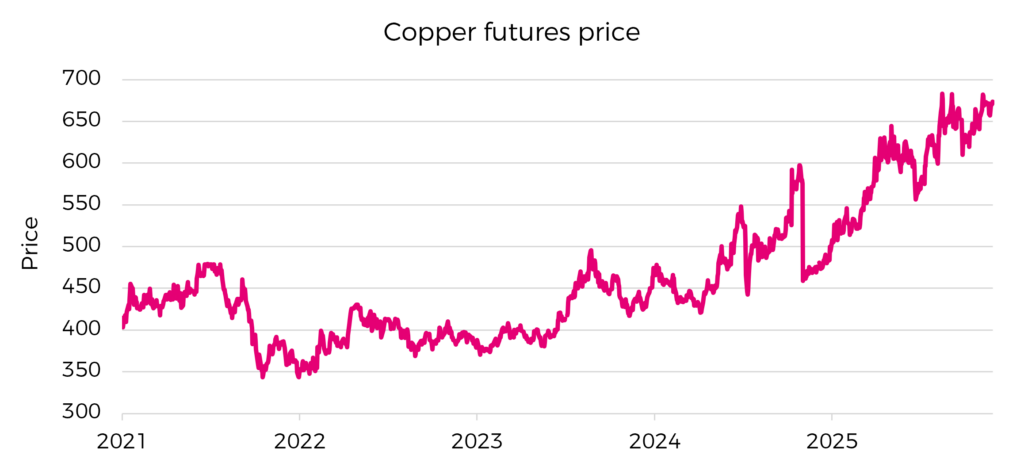
Source Bloomberg: 29.09.2021 to 25.08.2026. Past performance is not a reliable indicator of future returns.
Agriculture adds another layer. Food markets are exposed to weather, transport routes, fertiliser and fuel. None of these factors guarantees permanently higher inflation, and commodity prices are famously cyclical. But an economy with less redundancy can transmit shocks more quickly. That makes the route back to consistently low inflation less straightforward than a simple extrapolation of falling goods prices would suggest.
The uncomfortable meeting point: supply, inflation and sovereign borrowing
The corporate supply does not arrive in a vacuum. Governments are also issuing heavily. Bond investors are therefore being asked to finance fiscal deficits, refinancing needs, energy infrastructure and the AI capital-expenditure cycle at the same time. Each borrower can look manageable in isolation. Collectively, they compete for balance-sheet capacity and savings.
This is where the commodity argument becomes relevant to rates. If physical constraints keep inflation sticky, central banks have less room to cut interest rates aggressively. If governments still need to issue large amounts of debt, the long end must offer a yield that clears that supply. And if technology companies are simultaneously adding very large, long-dated transactions, the price of capital should not be assumed to fall simply because the borrowers are high quality.
There is a temptation to describe every official bond-market intervention as financial repression. I would be more cautious. Buybacks, liquidity operations and changes in issuance can have perfectly sensible market-structure objectives. But the broader tension is real. Highly indebted sovereigns prefer low funding costs; investors facing sticky inflation require adequate real returns. Commodities matter because they can expose the gap between the inflation rate policymakers would like and the cost base the physical economy is actually experiencing.
What does this mean for credit portfolios?
It does not mean avoiding credit. In fact, the income remains very attractive. The ICE BofA US Corporate Index yield was 5.41% on 20 August 2026. That is meaningful carry from an investment-grade market. The issue is that a decent yield at index level does not remove the need to ask what sits underneath it.
We continue to prefer the front end of the curve, where a high starting yield can do more of the work and where we are less dependent on getting a five- or ten-year inflation forecast exactly right. Short-dated bonds have lower sensitivity to moves in government yields, and the credit assessment is usually anchored to a refinancing or repayment date we can see. There are still default, liquidity and reinvestment risks, but the margin for error is generally easier to understand.
We also think the primary market will remain important, but only with discipline. New-issue concessions can be valuable when they are genuinely away from fair value and when we are comfortable with the likely future funding path. A concession is less helpful if it merely resets an issuer’s entire curve wider. The aim is to collect a series of sensible, incremental returns, then recycle capital when the opportunity has closed, rather than make one heroic call on AI, commodities or central banks.
Sector selection matters too. Utilities and grid companies may benefit from rising demand, but they also face very large capital requirements. Technology companies may possess outstanding businesses, but their debt can still be expensive. Energy companies may benefit from scarcity, but commodity cyclicality and political risk remain. A good story is not the same thing as a good bond.
The easy part of the AI trade may be over
AI can be transformational and still be difficult for bondholders. Productive investment creates growth, but it also creates supply. The more capital that is required, the more often issuers return to the market and the more selective investors must become about maturity, structure and price.
At the same time, the physical inputs behind the investment cycle are arguing against complacency on inflation. Refined products, copper, electricity networks and transport capacity are not abstractions. They take time and money to expand. If supply cannot respond quickly, prices will.
For us, the conclusion is fairly straightforward. Yields are high enough to be useful, particularly at the short end, but spreads and valuations leave less room for indiscriminate risk-taking. We want to be paid for financing the AI build-out, not simply impressed by it. In a market with heavy sovereign and corporate issuance, sticky inflation and increasingly visible commodity constraints, patience is not a failure to participate. It is part of the return strategy.