

For years, Iran’s influence over the Strait sat in the background of markets. It was real, understood, but mostly implicit. A tail risk rather than a central case.
The war has shifted that balance. The net effect has been to move Iran from a position of implied control to something far more explicit and, if the current ceasefire holds, arguably more durable and more profitable for Iran. That change matters for energy markets, inflation dynamics, and ultimately for rates.
Formalising the need for very expensive war insurance
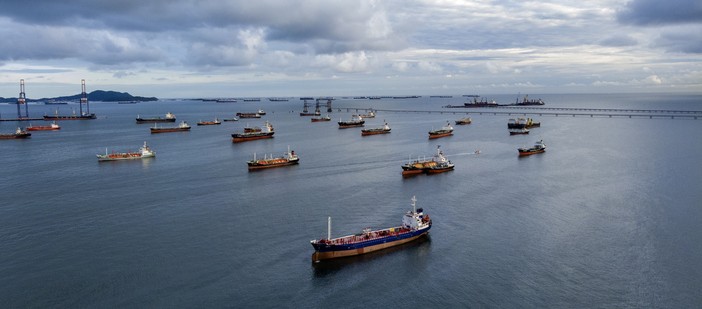
This conflict has seen war risk cover re-priced aggressively. Where cover was available, it shifted to voyage-by-voyage approval at eye watering cost. Faced with that uncertainty, shipowners anchored rather than transited.
The ceasefire does not unwind this new reality. If anything, it formalises it. Reporting around the ceasefire framework suggests that controlled passage through Hormuz will now involve an explicit transit fee, at around two million dollars per vessel. The Strait moves from being a free but risky passage to a priced chokepoint.
Before the war, Iran’s leverage over Hormuz was largely implicit. Threats existed, but monetisation did not. After the war, control has a line item. That is a meaningful strategic shift. It allows for selectivity, enforcement, and persistence. Friendly ships pass. Others wait. Compliance becomes part of the operating environment.
Once a system like that exists, it is rarely dismantled.
Costs up
It is worth being explicit about the cost base that markets are now dealing with. Pre-conflict, war risk insurance for a Hormuz transit was largely negligible in the context of a tanker voyage. Tens of thousands of dollars, sometimes less, and rarely a deciding factor.
During the conflict, quoted war risk premia jumped sharply. Estimates for large crude carriers moved into the hundreds of thousands or more per voyage, depending on hull value and terms. In stressed periods, all-in insurance costs approached or exceeded a million dollars per transit. Add in the toll and the economics change materially.
From a market perspective, this is crucial. Energy prices are set at the margin, and the marginal barrel is now more expensive to move.
Why the ceasefire does not necessarily mean stability
There is a temptation to view the ceasefire as de-escalation. From a market standpoint, that conclusion is premature.
The war has not produced regime change in Tehran. If anything, it appears to have reinforced the influence of harder line elements within the IRGC, shaped by the conflict itself. Commanders who have seen the effectiveness of economic leverage through Hormuz are unlikely to forget that lesson.
At the same time, a US brokered pause reduces immediate escalation risk for Washington but may do the opposite for others in the region. Israel, in particular, may see a frozen conflict that leaves Iran with enhanced leverage as unfinished business.
The incentives are asymmetric. Iran benefits from a controlled, monetised Strait. The US prioritises flow over confrontation. Other regional powers may be less comfortable with that equilibrium.
The result is a fragile status quo. Open water, persistent tension, and a high probability of renewed disruption whenever politics deteriorates.
For insurers, that means Hormuz remains one headline away from repricing. For shipowners, that uncertainty becomes permanent.
The inflation impact
First, higher insurance and transit costs raise the delivered price of crude, LNG, and refined products. Even if headline benchmarks fall back, the consumer sees a higher landed cost.
Second, energy is a transport cost as well as an input. Higher freight, fuel and fertiliser costs bleed into food prices, manufactured goods, and distribution margins. This is not confined to petrol.
Third, uncertainty itself is inflationary. When logistics are unreliable, inventories rise, supply chains lengthen, and pricing buffers widen. Insurance driven disruption is particularly persistent because it reappears quickly and with little warning.
This matters for rates. Markets can look through a one-off energy spike. They struggle with a structural repricing of supply chains. Hormuz has moved closer to the second category in our opinion.
Where this leaves us
Markets may be breathing a sigh of relief today, but the paradox of the Iran war is that Tehran may have emerged militarily constrained, yet strategically upgraded.
By converting implied leverage over Hormuz into explicit, priced control, Iran has turned geography into a repeatable source of influence. The ceasefire does not reverse that shift. It locks it in.
For markets, the implication is uncomfortable but clear. The world may avoid outright closure of the Strait, but it does not return to a frictionless status quo. Energy remains structurally more expensive at the margin, disruption risk remains elevated, and inflation pressures linger longer than headline calm would suggest.
We continue to see higher oil and oil derivatives prices in the months and years ahead from disruption and expense of transiting in the area. Given that credit spreads are relatively tight, we remain light on credit risk and relatively short duration as a result.